
Zaid Ahmad Khan of ZOLARYS on Why Human Judgment Still Wins in an AI-Saturated World
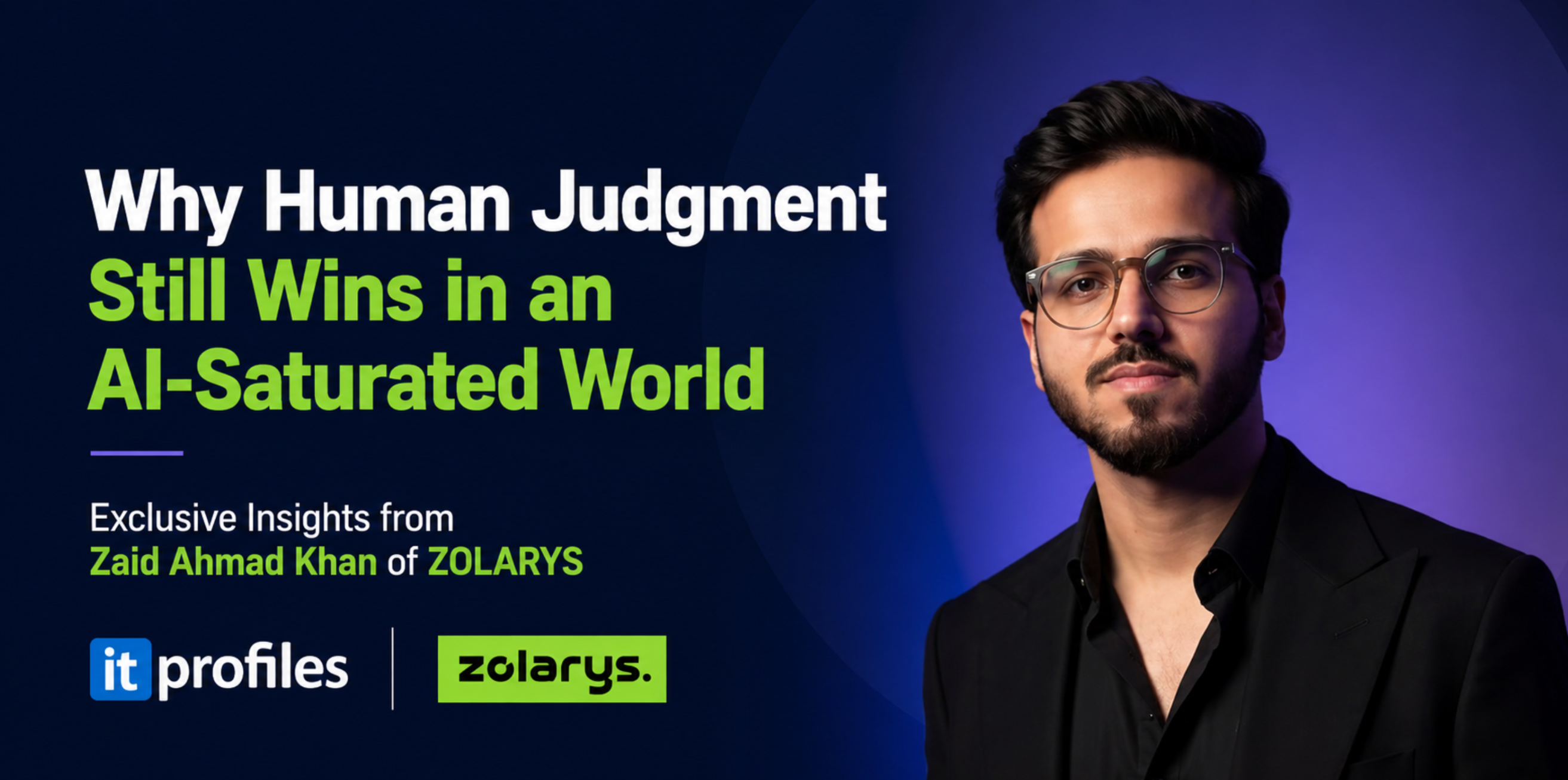
The conversation around AI has become strangely binary. One side treats automation like the answer to everything, while the other romanticizes human creativity as if technology never changed the game. In this conversation with ITProfiles, Zaid Ahmad Khan, Founder and CEO of ZOLARYS, sits somewhere far more realistic in the middle. He isn’t interested in selling fear around AI, nor is he convinced that speed alone creates meaningful work. For Zaid, the real shift happening right now has less to do with technology itself and more to do with what people are starting to miss. As content becomes faster, cheaper, and increasingly interchangeable, businesses are quietly rediscovering the value of judgment, personality, emotional context, and human presence. Not because machines are useless, but because audiences can now feel the difference between something generated and something genuinely understood.
The Real Premium Is Judgment
Cheap tools can produce endless options now. That’s no longer impressive. What still matters is knowing which option actually makes sense for the business sitting in front of you. As Zaid sees it, speed without judgment is just noise delivered faster. “AI offers speed but lacks the sense needed to make the right choices for your business.” That’s where human teams still hold their ground. Not because they work harder, but because they understand context, the kind no dashboard or prompt can fully capture. At ZOLARYS, the work rarely starts with execution. It starts with questions. A client might ask for something flashy or attention-grabbing, but the founder’s instinct is to pause and unpack the reason behind the request first. “We go a step further by asking, ‘Why do you want it to pop, and for whom?’” That extra layer changes everything. A tool can generate something visually sharp in seconds. But it won’t know the client is carrying pressure from a failed launch six months ago or trying to calm nervous investors before the next round. Those details quietly shape every smart decision, and frankly, they’re usually the reason good work feels human in the first place.
The Moment the Workflow Stops Working
Most AI-led development projects don’t fall apart in the beginning. In fact, they often look polished at first glance, clean visuals, decent copy, and smooth execution. The real cracks appear later, usually the moment something unpredictable enters the room. “Everything was fine until there was a real problem, a scope change, a conflicting requirement, a stakeholder disagreement.” That’s the part systems struggle with. Not the work itself, but the messy human side of work where priorities shift, opinions collide, and somebody has to make judgment calls on the fly. Zaid believes the bigger issue is that many of these projects feel technically correct but emotionally empty. The output checks boxes, yet somehow lacks personality. “It felt like it was made for a business, not their business.” That tiny distinction is usually the difference between work people remember and work they scroll past without a second thought. Then comes the part most workflows completely ignore: trust. When things start wobbling, clients don’t just want updates, they want reassurance that someone is actually in the trenches with them. A tool can generate deliverables. It can’t pick up the phone and say, “We’ll figure this out.” And honestly, that’s usually when clients start looking for real partners again.
Calm Comes From Transparency
When projects hit a wall, most clients aren’t looking for a technical lecture. They’re looking for reassurance that someone is paying attention and taking ownership. For Zaid, the first response matters more than the perfect explanation. “First thing I do is acknowledge, not explain.” That small shift changes the tone immediately. Instead of overwhelming clients with details, the focus stays on making them feel seen before moving into solutions. Strange as it sounds, people handle bad news far better when they don’t feel blindsided by it. The founder also believes trust grows faster through honesty than perfection. Rather than quietly scrambling behind the scenes, he brings issues forward early, even when the full answer isn’t ready yet. “The moment I sense something is off, I bring it up before they ask.” That kind of transparency tends to calm clients more than polished silence ever will. There’s also a subtle language game happening in difficult moments. At ZOLARYS, problems are framed collectively, “we hit a wall” instead of “our team made an error.” It sounds minor, but it changes the emotional dynamic completely. Clients stop feeling managed and start feeling supported, which is usually what keeps trust intact when things get messy.
The Return of the Human Fingerprint
As more digital work starts blending into the same polished, predictable style, originality is quietly becoming a luxury again. Zaid sees this shift happening faster than most agencies realize, especially in branding and design, where audiences can now spot templated work almost instantly. “When everything starts looking AI-generated, anything with a genuine human fingerprint becomes rare.” And rare things naturally attract attention. Not because they’re louder, but because they feel considered. A slightly imperfect idea with personality often lands harder than something technically flawless but emotionally flat. At the same time, the founder is careful not to romanticize the label itself. Calling something “human-led” means very little if the final work still feels generic. Audiences are sharper than agencies give them credit for, and they can usually tell when “handcrafted” is just another marketing sticker. For ZOLARYS, the proof sits inside the details, the odd creative choice, the unexpected angle, the tiny bits of storytelling that don’t come from templates. That’s the part machines still struggle to fake convincingly. And frankly, it’s also the part people remember long after the campaign ends.
Listening Beyond the Brief
While most teams rush to execution, Zaid believes the real work starts much earlier, somewhere between what clients say and what they actually mean. At ZOLARYS, the focus is shifting toward what he calls deeper listening, the ability to understand the emotional layer underneath the brief. “Deep listening before deep designing.” For the founder, that means paying attention not just to goals and deliverables, but to the anxieties sitting quietly behind them. Sometimes it’s a founder trying to recover from a failed launch. Sometimes it’s investor pressure disguised as urgency. Those unspoken details often shape better decisions than the brief itself. The same thinking applies creatively too. A concept can look polished, strategic, and technically correct while still feeling strangely lifeless. Zaid believes knowing the difference comes from years of consuming, questioning, and critiquing work, not from generating endless variations until something sticks. There’s also a relationship layer many teams underestimate. Clients rarely stay because of deliverables alone. They stay because they feel understood. “The ability to make a client feel genuinely cared for, rather than simply served, transforms a single project into a long-term partnership.” And honestly, that’s the kind of retention strategy no software subscription has figured out yet.
A Brand Without an Opinion Sounds Empty
The internet has become painfully crowded with polished content that says all the right things while somehow saying nothing at all. For Zaid, the easiest way to disappear today is to sound agreeable to everyone. “We have an opinion and we share it; we don't just inform, we argue a point.” That approach naturally creates friction, and that’s exactly why it works. Brands that try too hard to please everyone usually end up sounding interchangeable. The ones people remember tend to have a perspective strong enough to attract some people and repel others. At ZOLARYS, personality is built into the process itself. Instead of only showcasing polished outcomes, the team shares the messy middle too, the iterations, the second guesses, the moments where ideas evolve halfway through execution. Oddly enough, those imperfections make the work feel more trustworthy. The founder believes audiences can sense when there’s a real person behind the screen. Not because the content is flawless, but because it carries small traces of human behavior, curiosity, conviction, even inconsistency now and then. And frankly, in a world full of perfectly optimized content, a little humanity has become surprisingly refreshing.
The Things You Can’t Prompt Correctly
For all the speed and efficiency technology brings, Zaid believes there’s still one blind spot it hasn’t figured out, cultural instinct. Not data. Not execution. Just the quiet human understanding of how people from different backgrounds actually communicate and build trust. “Relationship always comes before transaction.” In many of the markets ZOLARYS works with, business doesn’t begin with a pitch deck or proposal. It begins with tone, patience, and reading the room properly. Push too fast and you look transactional. Move too softly and you risk sounding uncertain. That balance is rarely written down anywhere, but people immediately feel when it’s wrong. The founder points out that most systems are trained on a heavily Western version of communication. Naturally, that shapes the outputs too. A style that feels confident in one culture can sound cold or aggressive somewhere else. Meanwhile, politeness in another region may accidentally come across as vague or hesitant. “That calibration is deeply human.” It comes from lived interaction, observation, and understanding social nuance beyond words themselves. And honestly, that’s probably why some conversations still feel better over coffee than over automation, even in a world obsessed with scaling everything.
Knowing When Not to Move Forward
Most conversations around instinct focus on bold decisions, the big leap, the risky bet, the visionary move. But Zaid sees intuition a little differently. For him, the real skill often lies in restraint. “People often talk about instinct as a way of knowing what to do. But I believe the true skill is knowing when to stop.” That kind of judgment usually appears long before a problem becomes obvious. Sometimes a project looks exciting on paper yet quietly feels wrong underneath, and experienced founders learn to notice that tension early. At ZOLARYS, instinct isn’t treated as magic or guesswork. It’s closer to pattern awareness shaped by experience, pressure, and plenty of mistakes along the way. The difficult part is having the confidence to walk away from an idea everyone else seems excited about because deep down, you already know it won’t survive outside the presentation deck. The founder believes this is where automation still struggles. Systems are built to keep generating, refining, and pushing forward endlessly. They don’t naturally understand the value of hesitation. “One of the most crucial things a founder can do is to recognize when to change direction completely.” And honestly, that hesitation matters because humans carry consequences. Reputation, wasted time, financial risk, real people feel the weight of those decisions. Machines don’t. Which is probably why knowing when to stop remains one of the most human business instincts left.
When Everything Starts Looking the Same
The market didn’t suddenly become obsessed with premium strategy. According to Zaid, what actually happened is simpler, people got exhausted by sameness. Once fast, low-cost content became available everywhere, businesses started noticing how identical everything began to feel. “AI flooded the market with cheap, fast, average work.” The problem isn’t necessarily quality in isolation. It’s repetition. Clients now scroll through websites, campaigns and brand messaging that all carry the same rhythm, the same structure, and strangely enough, even the same personality. That shift has quietly changed what people value. Companies aren’t just looking for execution anymore; they’re searching for distinction. Something that feels like it belongs specifically to them instead of sounding like a polished remix of ten competitors in the same category. Zaid believes this is why thoughtful strategy suddenly feels premium again. Not because human-led work became dramatically better overnight, but because originality became harder to find. “So the question isn't ‘why pay more for human strategy’ anymore, it's ‘can I afford not to?’” And honestly, that might be the strangest side effect of this entire shift: human work didn’t necessarily become luxurious. It just became noticeably harder to replace.
The Future Isn’t Anti-AI, It’s Pro-Human
Zaid doesn’t believe the world is heading toward some dramatic rejection of automation. The convenience is too powerful, the scale too useful, and frankly, businesses rarely walk away from efficiency once they’ve tasted it. The bot-first world is staying. But so is the growing exhaustion surrounding it. “People are becoming fatigued.” Not necessarily because the technology is bad, but because too much of it now feels emotionally flat. The same polished replies. The same overly smooth content. The same strangely personality-free brand voices are showing up everywhere at once. Instead of a full “back to humans” rebellion, the founder sees something more subtle happening. Human involvement itself is slowly becoming a quality signal. Much like people notice phrases such as “locally sourced” or “handcrafted,” audiences are beginning to value signs that real people shaped the experience behind a product or brand. At ZOLARYS, the belief is that the future belongs to balance, not extremes. Human judgment brings taste, context, and emotional awareness, while technology handles the speed and operational weight. The agencies that survive won’t be the ones pretending automation doesn’t exist. They’ll be the ones smart enough to use it without letting everything start sounding like it came from the same machine.